Ok, so day two in Venice was much cloudier than day one. I saw this on the weather and dressed accordingly but weather in Venice can be very unpredictable and it was sunny by the end of the day, (Weather Guessers called for rain). The clouds really affect the temperature and it was even cooler than the first day. We started out today with a tour of the city by our great history professor Lorenzo and Andrew, a very knowledgeable drawing teacher. Ali and I went to Murano as well with a friend Matteo.

As we were crossing the bridge to get out of the Academia neighborhood, Lorenzo told us about how the Venetians were traders and traveled all over. Marco Polo (a Venetian), walked to China, it took him 6 years! He wrote about his travels and nobody believed him. As a result from all of these travels (and a prime shipping location and situation) Venice developed as a blend between the East and the West. This is very evident in the architecture and the domes which almost look like mosques from southwestern Asia.
Lorenzo informed us that most of Venice was built around the 1470s but the town was originally settled in the 400s by Romans trying to escape the invading barbarians when the Roman empire collapsed. They came here to Venice which at the time was a near inhabitable swampland right on the ocean. The water was salty and the soil was muck unfit for building on. The Venetians would find clever solutions around these problems.

To build on this swampland, The Venetians took pine logs 10 meters tall (30 feet), and tied them together. They then sank these straight down into the mud. This made a solid foundation from which they could build off of. The trees would become completely submerged and as a result were air tight. This means that although the trees were submerged hundreds of years ago, they never rot and only a few have had to be replaced over the years. With style of foundation however, every bell tower in the city (there are over 90 churches in Venice) has a lean to it. Not quite as much as the leaning tower in Pisa, but they are definitely leaning.

We got back to Piazza San Marco and there were pigeons everywhere! Our professors told us that in feeding the pigeons used to be legal here and there were people selling bags of pigeon food for the tourists all over in this square! If you notice, many of the beautiful white buildings aren't so white anymore and this isn't just because of pollution in the air, it is also because of all of the pigeons pooping on the buildings! They must have figured that they weren't making enough money selling pigeon food to clean all the buildings so they stopped. These people were feeding the flying rats and they would land on you and you would be covered with Pigeons! The carriers of the modern plague. No thanks, I will pass on this one.

Our professors had some interesting things to say about the Duomo of Venice, St. Marks Basilica. Back in the 800s, Mark the Evangelist died in the city of Alexandria in Egypt and he was buried in Alexandria. He didn't stay there for very long however, as some Venetians came and dug up his body and took it back to Venice! The mosaic all the way to the right in the front of the Basilica depicts how the Venetians got his body past the customs in Alexandria. At the time, most people in Alexandria were muslim and they were forbidden to eat meat. Knowing this, the Venetians hid Marks corpse in a basket full of meat and covered it up with some cloth. When the muslim customs men asked what was in the basket, the venetians showed them the meat and as you can see, the custom guards were repulsed and didn't want anything to do with it. When they got Marks body back to Venice, they built this Duomo on top of it. Pretty neat!

This mosaic was all the way to the left of the front of the Basilica. You can see the differences in style as this one is very eastern. Even the mosaics are very eastern and in the west they would have all been Frescoes.
These four horses on top of the main entrance to the Basilica used to be solid gold (hollow on the inside to relieve weight). When Napoleon came to Venice, he took those horses. They have since been replaced by some not so expensive copies.
Speaking of Napoleon, when Napoleon was in Venice, he thought so highly of himself that he had a statue of himself put in the center on top of that building. When Napoleon left, the Venetians tore down his statue. They did not like Napoleon. The statue that is missing was Napoleons statue.
We walked through some of the narrow crowded streets of Venice that lead to the Rialto bridge (the equivalent of Florence's Ponte Vecchio, but also a key way to get from one neighborhood to the other neighborhood). Lots of tourists go to the rialto bridge and you can imagine how many shops there are selling masks, "murano" glass, bags, and all sorts of other touristy junk. But it makes people happy.
I mentioned before about how the Venetians had a hard time getting fresh water because they are on a swampy island right on the ocean and all the water is salty. This is a Venetian well, they are found in pretty much every campo and in Piazza San Marco and there may be one or two or sometimes more in a campo.
There are collection points for rain water to get into the well.
Perhaps the most ingenious feature with these wells is the inside of them is lined with a layer of clay. this clay filters out the salt in the sea water and lets fresh clean water accumulate in the well. The Venetians were creative problem solvers.
Another problem faced by the Venetians was the wet salty ocean air. When they had chimneys, they would always have problems with the smoke not rising enough to go out of the chimneys and as a result, the Venetians have special chimneys to accomadate the ocean air. Chimneys are often decorated very nicely and some people like to show off and show that they have the best chimney.
Our Professors then took us to the Jewish Ghettos in Venice. Originally, the term, "ghetto" was used to refer to the part of town where all the metal working was done. Obviously the meaning has changed several times throughout history. Persecution of the jews went on throughout history as well and Italy doesn't really have too big of a jewish population.
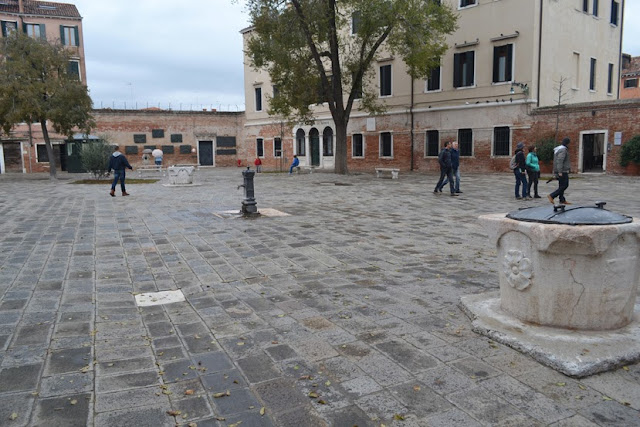
In Venice, persecution of the Jews started around the 1500s and obviously, during 1940's with the Nazi Party in power in Germany and Mussolini allied with Hitler, things got really bad here in the Jewish ghettos and they were sealed. As a result, the buildings in the jewish ghetto are 1-2 stories higher than in the rest of the city. With nowhere else to go, Jewish families just built upwards as new generations and new families struggled to find a place to live. The small jewish ghetto got a bit over crowded for awhile until the SS started sending people away. Much of the things that sealed the ghetto in have been removed but they have left one wall with barbed wire still on it as a reminder to the atrocities of the time.
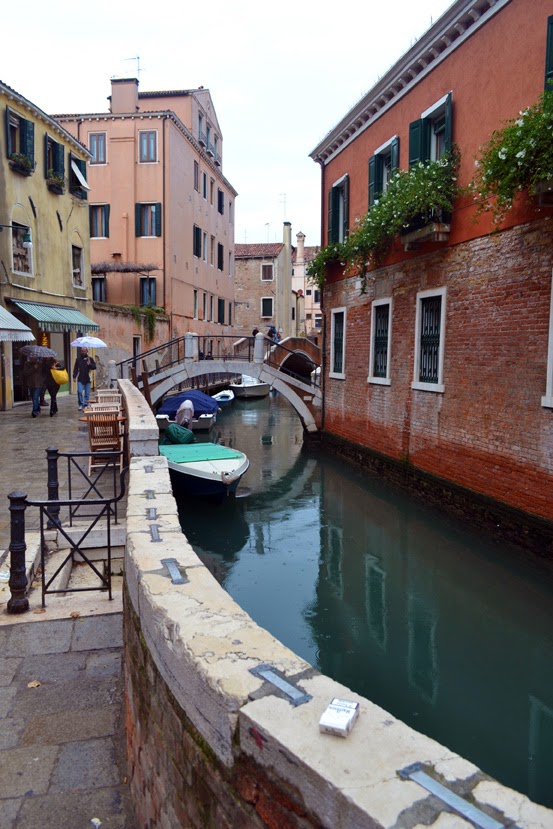
We then started walking back to the "Acadmia" neighborhood of Venice. We passed many beautiful canals. Venice is like Cinque Terre in the sense that everywhere you look, it is beautiful.
In Venice they seem to have lots of these outdoor fruit stand markets and even fish stand markets set up in Campos. There are more local stores too and not as many grocery stores as in Florence.
When we got back to L'Academia, Andrew told us that we were going to go on a boat ride around the canals and that we should get lunch really quick and get ready and meet back in about a half hour.
I didn't know what to expect after riding the bus taxi Vaporetto boats a bunch. I certainly didn't expect a smaller private taxi boat like this! We were so close to the water, it was like standing on the water. It was a whole new way to see the city. I took lots of photos......
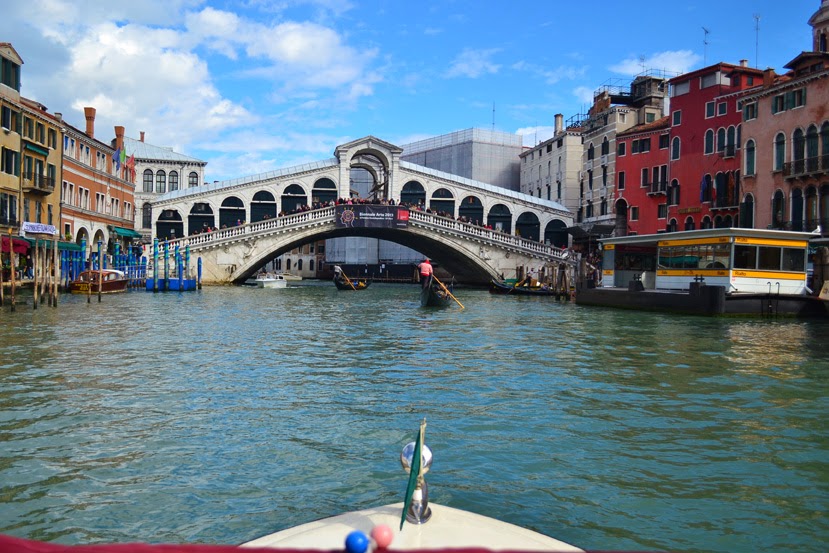
Thats the Rialto bridge. Its spans the Grand Canal. To the right you can see a Vaporetto stop.
This looked like a much larger outdoor fruit market. I later learned that this is a big market with fish and things and it is the "Rialto Market". The big green boat with a crane is a cargo boat. Everything is a boat in Venice. There are even ambulance boats, police boats and UPS boats!
We passed the train station and to a somewhat more modern part of Venice and we saw this cool bridge.
Here is another cool bridge!
I love how the steps just lead out into the water on many buildings. This is still low tide in Venice. if you look at the dark color on the walls of the canal, that is where high tide is. Its pretty wild and as boats create lots of waves at high tide, water spills over the edges and onto the edges of the sidewalk every day! Venice has a big problem with flooding when storms come. It is true that the city is sinking a millimeter or so a year. In 250 years the city would be in big trouble but they are working on a huge system of dikes to save the city. Similar systems are already in place in places in Northern Europe. With the Italian government not having money, and the speed of construction around here, I would say in about 80 years, the dike will be done and the Venetians won't have to worry anymore.

Piazza San Marco from the canals. Before Venice was linked to the mainland by the long bridge, the only way to get there was by boat. Everyone entered the city through those 2 pillars and into Piazza San Marco. The islands around Venice still can only be accessed by boat.
I like this church. Its really big and looks neat.
Peggy Guggenheim has a house and museum here right down the canal from the last church. Today some of the Guggenheim collections are shown here and exhibits are held as well to go along with the Biennale.
I took a quick photo of our boat as we were getting off back in Academia.
After the boat tour we were free as birds for the next few hours. We just had to meet back at the hotel by 4:00 to grab our bags and catch the 5:30 train back to Florence. Its always good to leave plenty of time for everything in Venice.
And with that Ali and I went straight to the Vaporetto to find out how to get to Murano. Our friend Matteo who is curios about glass decided to tag along.
After riding on line 1 to get to the, "Ferrovia" (Train Station, literally translating to "iron travel"), we caught line the orange line 3 that goes straight to Murano with a bunch of tourists. A short boat ride and Ali and I couldn't believe where we were!
Like in Venice, Murano is all canals, Murano is part of Venice. The streets were lined with touristy glass shops but there were more better glass shops than in Venice and not all of the glass shops were terrible selling "Murano Glass" from China.
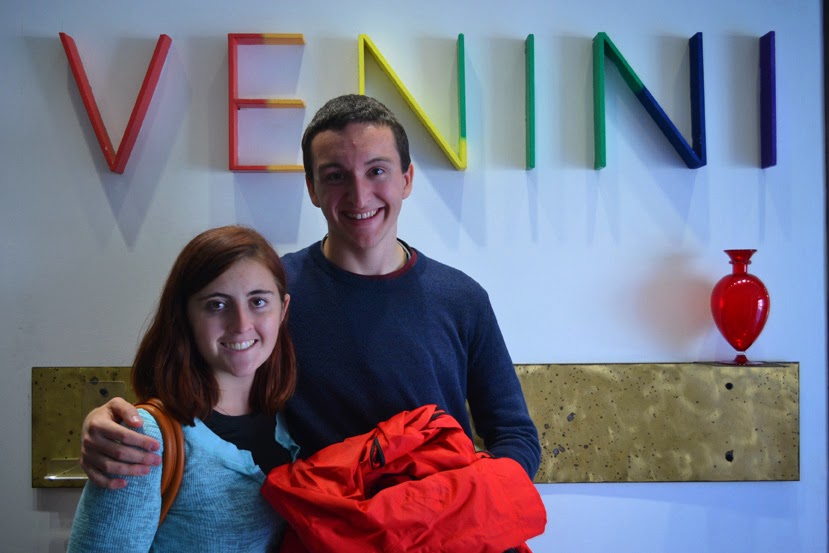
Ali and I had to go here. Our teacher Fred Tschida always had a giant "Venini" binder that was full of these amazing glass creations. Only 1000 of that binder were made but it was full of amazing glass creations. Ali and I couldn't believe we get to see them in person. Almost everything in this gallery we saw in Fred's book. We loved seeing them in person!
Glass Bird!
This is just so cool! I want to blow glass into metal like that.
These are awesome vessels with perfect incalmo stripes of color. They might be my favorite in the entire place but then again, they all are just so amazing!
These are really neat and I don't remember seeing them in the book.
I also don't remember seeing these flowers.
These murrine vessels are neat. I want to try something like this.
These were in the binder as well. We looked at some of the books they had there but none of them seemed as good as Fred's binder. Venini was started in 1923 I believe..... Maybe for their 100 year anniversary they will make something special. We asked what Venini was and how it all got started and the lady said that a lawyer from Milan really liked the glass from Murano so he commissioned all of these Master glassblowers to start making some of their best ideas and the Venini gallery resulted from those works. It is probably my favorite glass gallery in Venice.

We were heading into the center of Murano to find the Carlo Dona tool shop and we were also looking for "Pesce" street to try and meet a master glassblower, Dino Rosin, who our professors told us about. The people working at the touristy glass shops were clueless and didn't know anything. I don't even think they are from Venice.
We saw this sculpture along the way and decided to check it out. It looks really neat!
I think it lights up at night. it would be really cool to see it then! It was really big!
After some more searching, and more asking, we finally asked an old man, "Dove e Carlo Dona? Ferramenta di vetro?" (Where is Carlo Dona? Glass tool shop?). After a bit more talking, he told us to follow him and he led us right to it. We were so happy to be there!
Ali was so excited! So many glass tools! We met Roberto Dona, Carlo Dona's grandson. Carlo still works with his father and grandfather to hand-make every tool. Glass tools aren't mass produced because there simply isn't enough demand for them. Carlo Dona tools are some of the best in the world. We explained to Roberto that we were students at Alfred University and we both blow glass. We talked with him for probably about a 45 minutes or so. We also bought some glass tools.

Ali, me, and Roberto Dona. Roberto spoke english and he had heard about Alfred University and both of our professors. He met them all at GAS (Glass Art Society) conferences. Ali and I want to go to one of these. Roberto informed us that all the real Murano glass shops are only open on the weekend and sometimes saturday mornings and that Dino would be closed. All the touristy shops stay open. He said that if we came back on a weekday, he could call Dino for us and take us right to Pesche street! Roberto was very nice and we were glad to have met him. We also both really want to go back to Murano on a week day!
After awhile, we said goodbye to Roberto and headed to grab a quick bit to eat before catching the boat back to Venice so we could meet back with the group and catch the train back.
While heading back to the boat for Venice, we went by Cesare Toffolo's glass gallery and it was open. Ali and I both know Toffolo is a flameworking glass Maestro so we decided to stop by. These little goblets in the window were TINY!
Toffolo's stuff was incredible! It is pretty big for a flame worker and I wonder how big his torch is. I would like to see him in action. My glass teacher Aric says he has actually been living in Baltimore for the past few years! He speaks only Italian but now that I know some Italian, I may want to track him down and get in touch with him.
The classic "Dragon Stem"
Once again, the detail on these was just phenomenal! I really want to watch Toffolo blow glass. He makes me really want to learn lamp working. It is much more affordable than the hotshop glassblowing than Ali and I do.
Heading back to Venice. What a great day!
We had seen this statue many times in front of this building, across the canal from Piazza San Marco. When we got close to it on the boat, we could see that it is actually inflatable! NeatO!
The Vaporetto ride back to the Ferrovia, (train station) was extremely crowded. In Venice, you shove your way onto the Vaporetto.
In the front of all the gondolas there is this metal symbol. In the front there are 6 notches, one for each of the, "neighborhoods" or sections of Venice. The notch on the back is for Giudecca (the long group of islands between Venice and the sea).

Back on the train. It was a bummer to see cars again but alas we must leave the magic city. I loved Venice. It is definitely my favorite city in Europe so far. Not to mention, the glass Mecca Murano is there, AND one of the greatest international art exhibitions is there so Venice is the place to be for Ali and I. I am so behind on my blog posts because of midterms coming up, and Ali's mom being here and my Mom, Grandma Dottie, and Aunt Patty being here. I went back to Venice the following weekend with my Mom and Grandma Dottie and Aunt Patty. I also went back to Murano. That deserves a blog post right there! However, I have no time. I will be taking my midterms in a few hours, then hopping on a train to Pisa where Ali and I will fly to Paris early tomorrow morning. We will be spending 9 days in Paris and I am going to try and keep the blog updated as much as I can! Im loving it here in Europe and Ali and I NEED to go back to Murano and Venice!